
Silver Theme Machine
Not to lose now but to win?

Before I begin — and because this will be the very first Tyranny of Small Decisions that most of you have found delivered directly to your inbox — I thought I’d drop a quick paragraph in here to say massive thanks to everybody who jumped onto my Substack on Tuesday morning. With only a single call-to-action — and no fuss or badgering — more than two hundred and fifty of you splendid human beings hopped over to my new home and hit the subscribe button! I can’t even start to explain how happy this has made me. (Though, obviously, I will attempt to describe exactly how happy this made me — and talk about some other interesting metrics that the move has brought to light — in the very near future).
However, in the meantime, I’ll waffle on a bit about games. Because that’s what you really came for, isn’t it?… 😄
My board game purchases seem to have gone in a bit of an odd direction this year. I’m not sure that it’s been an entirely pre-meditated decision, but 2025 certainly seems to have started out with a theme of “looking for something a little bit different…”
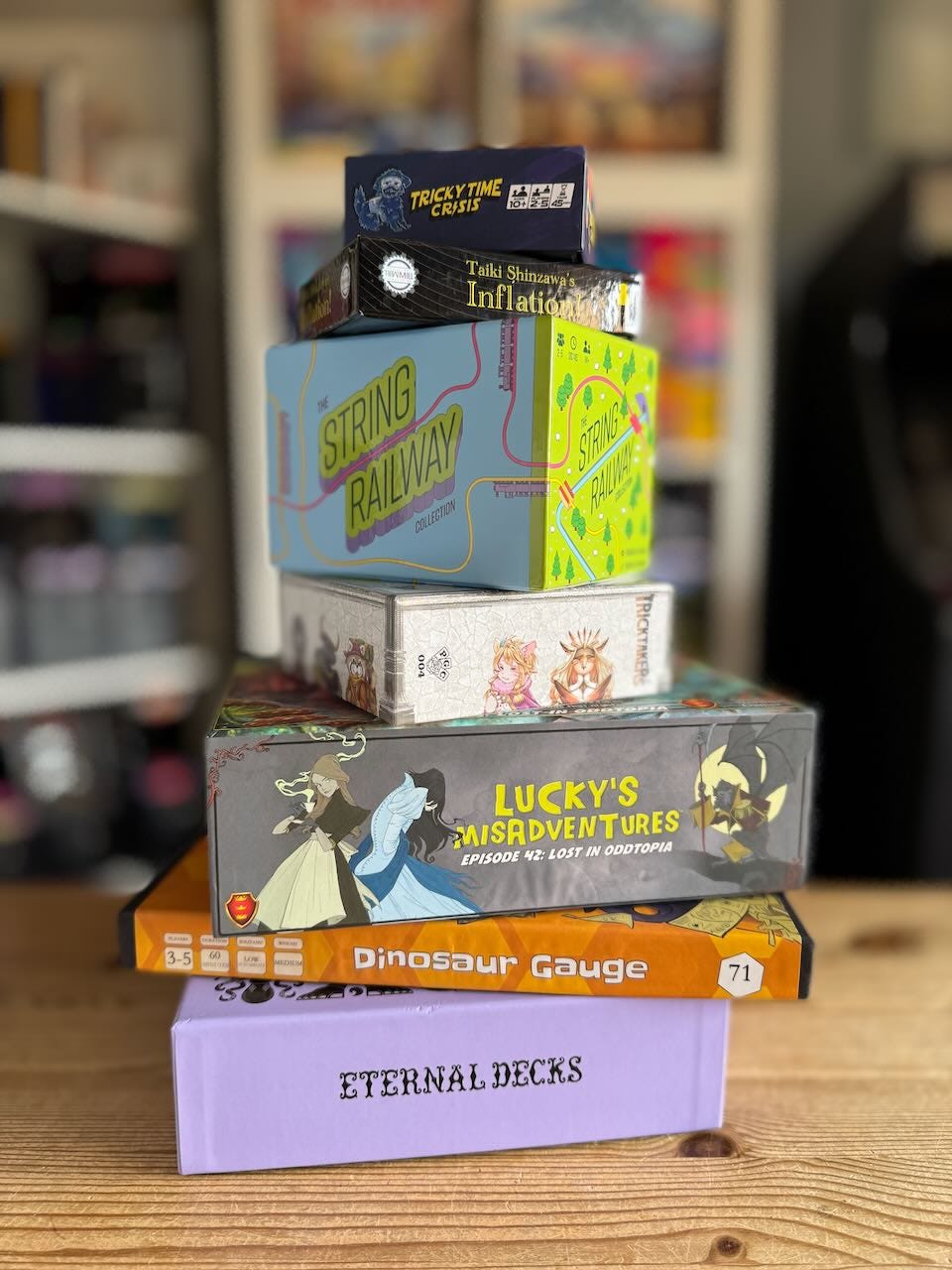
Over on the Five Games for Doomsday Discord, the notion that we’re currently living through a Silver Age of modern board gaming is a thing that’s frequently referenced.
The theory — which I’d urge you to seek out an explanation of from 5G4D’s Ben Maddox, because he’s the man responsible for it and seems to explain the whole thing way better than anybody else does — goes a bit like this:
We’ve recently gone through the “Golden Age” of modern board gaming — a period which saw a surge in games with original, clever, and elegant mechanisms…mechanisms which nobody had really seen before, and which we all very much enjoyed experiencing for the first time. But now we’re into the Silver age … a time in which we’re not really seeing so many new elements in board games, but instead seeing previously-used mechanisms being presented in increasingly-complicated (some-might-say laborious!) combinations. “Silver Age” games are often well-crafted, look great, and might have really novel themes attached to them … but ultimately, upon playing them, you’re often just left with a bit of a feeling of “well, that was another perfectly playable game … in a mountain of perfectly playable games…”
Of course, these “Silver Age” games wouldn’t be getting published if they weren’t selling well, and there’s certainly an appetite for them with the games-buying public. New people discover the joys of modern board gaming every day; maybe their first brush with worker placement, or with engine building, or with rondels …or whatever mechanism you care to name will be in one of these titles …and, because of that, they’ll fall in love with whatever-it-is, and THAT will be a game that’ll always be special to them.
But for me, personally …I’ve started to find that when another “Silver age” game is slapped down onto the table in front of me… my heart sinks a little bit.
It’s definitely not “new game fatigue”. It’s playing-things-with-a-lack-of-innovation-fatigue.
Silver fatigue.
Which is probably why I’ve started looking towards less-mainstream releases in my purchasing. The difficult part, of course, is finding the less-mainstream releases which also happen to be very good games. But hopefully I’m getting better at that.
The global economy is in a very strange place right now. When markets become difficult, indie companies start hanging on by their fingernails, and big companies switch to safe bets. And I fear that the safe bets right now are likely to be… the most silver of silver-age titles.
Mind how you go. Things are about to get pretty bland out there… 😔
Anway, enough of this waffle … let’s talk about one of those definitely-not-silver games in the heap shown above:
Inflation! (Taiki Shinzawa, 2019)
“Inflation!” (previously called “Zimbabweee Trick”) is a game which I’ve fancied getting my hands on for quite a while. It’s perhaps a tiny bit pricy for a small-box card game (here in the UK at least), which has put me off the purchase a little bit in the past … but, I guess that this recent drive to get my hands on things that are unique-but-emminently-playable was always going to win out in the end 😜
Inflation! is a particularly unusual trick taker, which works like this:
The deck contains 55 cards featuring a numbers ranging from 1 to 10. There’s a single card of value one, two cards of value two, three cards of value three … all the way up to ten cards of value 10.
You can also think of each number as a suit. So, for example, the “3” suit has 3 cards in it. All showing the number 3. (and all the same colour … grey, in this instance).
The first player leads a card, and this is a “must-follow” trick taker… so, if the lead player plays a three, and the next player in the round has a three in their hand, they have to play a three as well. But if that next player doesn’t have a three (and — by the power of maths — in a four player game at least one of those players isn’t going to be holding a three), then they can then play whichever card they wish.
Once everybody has played a card, whichever player played the highest number wins the trick (and takes a button from the supply to mark the win … yes, the game comes with buttons for scoring. Which is kind of lo-fi and cute). Or, if there was a tie for the highest number, the person who played their “winning” card later in the round wins the tie.
Now… here’s where it gets interesting: instead of discarding the card that you played in round one (like you would in pretty much any other trick taker…), you leave it on the table. Another trick is played, but this time you place your new card so that it overlaps the card from the previous round to form a two digit number! (or maybe even a three digit number, if your second card happened to be a 10). And once again… the highest number in front of a player wins the trick.
“Oooh!”
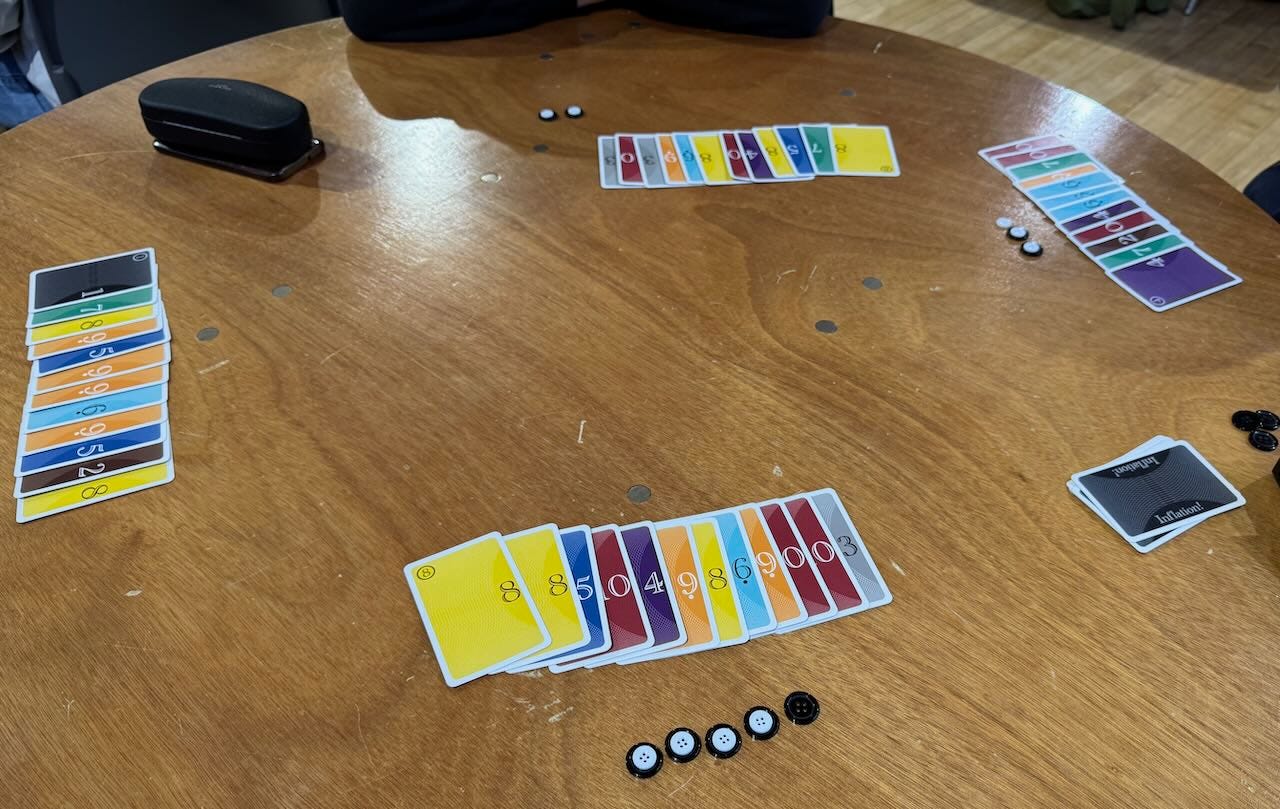
…and you keep going, and winning/losing tricks, until you’ve played your way through a full round of 12 cards. So — as an example -- in that photo above, I’ve just won the final trick of the round by playing the number 885,049,869,003 😁
Is your mind completely blown yet? 🤯 Well… I’m not quite done… because there’s one more twist. Winning that round with 885,049,869,003 turned out to be a really, really bad move in this instance…
Why?
Well… Inflation is also one of those games where — before each round begins — players are asked to predict how many tricks they’re going to win. The person who won the most tricks in a given round (and ONLY that person) is then subjected to one final gotcha: they will only score if they got thier prediction exactly right. Get it correct, and you score two points for each trick that you won. Take too many (or even too few!) tricks … and you go bust and score zero for that round.
(Meanwhile, everybody else scores 1 point per trick, irrespective of their prediction).
Which all feels a little bit like: 🤯🤯😁😱😂
The way that your number builds up… the uneven (but totally logical) distribution of cards… the trackability of cards already played… the way that a card played as a “10” turns into a “0” on the subsequent round when its left-most digit is up covered up (see those red cards in the photo?)… the way you need to win tricks, but not win too many tricks unless somebody else is already winning WAY too many tricks… all these things combine perfectly into a thinky, super-strategic, boisterous trick-taker with bags of interaction and opportunity for screwage.
Inflation is probably not a game that you’d want to play with trick-taking newbies. The nuances of the game are pretty brain-scrambling even when Inflation! is NOT your first trick-taking rodeo.
But it is good.
It’s very good.
Recommended 😁
Everything that came after the Beige Age is only bling and decadence anyway.