
Skara Play
A middening experience?

I’ve been playing a fair bit of Skara Brae over the last week or so. Mostly solo. This is a very odd turn of events.
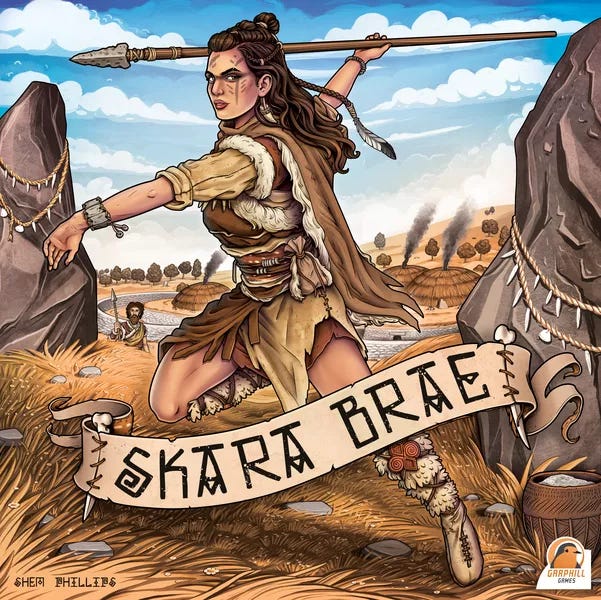
Hmmm. Skara Brae.
Me and Skara Brae have history.
Skara Brae is a cause of very bad memories for me.
Not Skara Brae the board game, you understand … but Skara Brae, the place.
Skara Brae is a neolithic settlement on the island of Orkney, which I last visited about 20 years ago. A visit which was somewhat marred by the fact that — in a particularly butter-fingered moment — I managed to drop a somewhat-expensive video camera (my pride and joy!) onto an ancient and particularly deep-set section of ancient stone flooring.
Can you guess which came out better, in a collision between an early 21st-century Sony camcorder and a 5,000-year-old piece of neolithic flagstone?
Yep, that’s right … the camera was a write-off 😭
So why, you might wonder, would I ever buy a board game that would remind me of such a disasterous and anguish-causing turn of events?
Well… we’ll be re-visiting the scene of the mishap in a few weeks time, when we return to Orkney for a bit of a holiday. So when I saw a game called Skara Brae popping up in the new release schedule a few weeks ago, it kind of randomly pranged my interest. And when I read a bit more about it… it struck me that Skara Brae might actually be my kind of game. Or if not… at least it would be an amusing thing to take to Orkney and play in our holiday rental… 😄
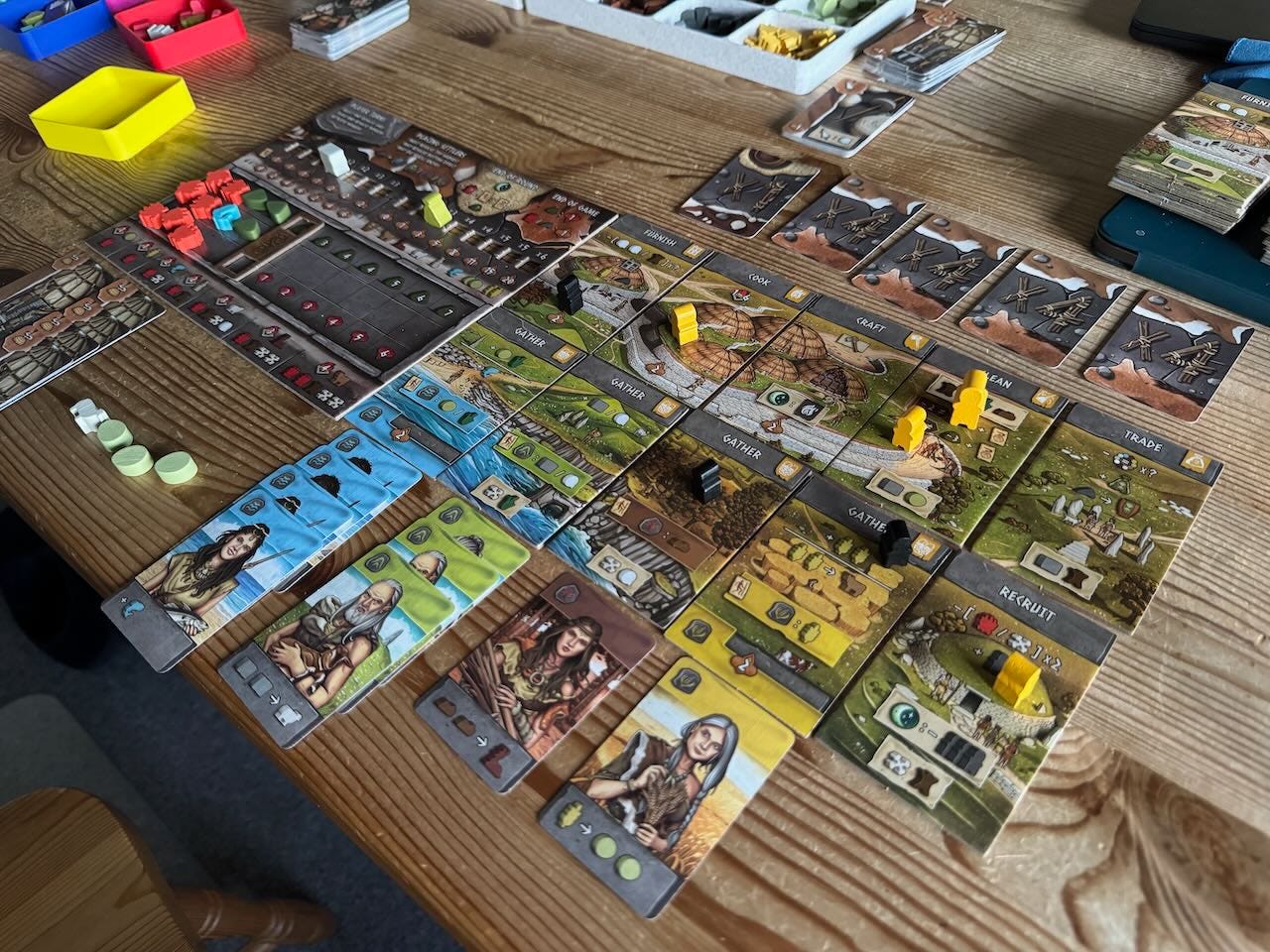
So what kind of game is Skara Brae, and what has compelled me to play it multiple times … even in solo mode!??
OK, let’s start with the basics: Skara Brae is a resource conversion game. There are many resources for players to harvest and “convert” (and ultimately funnel into victory point generation). 16 of them in total. All represented by different wooden pieces.
Next… there’s a little bit of card drafting going on at the start of each turn.
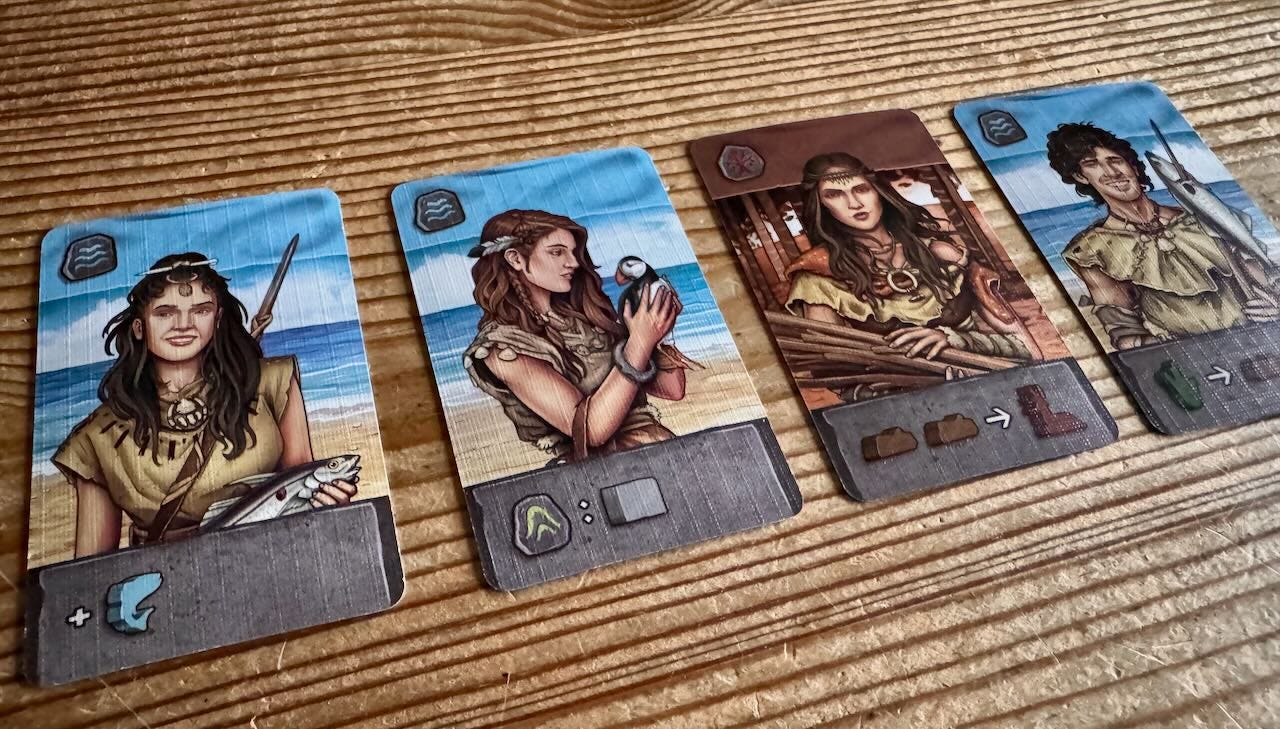
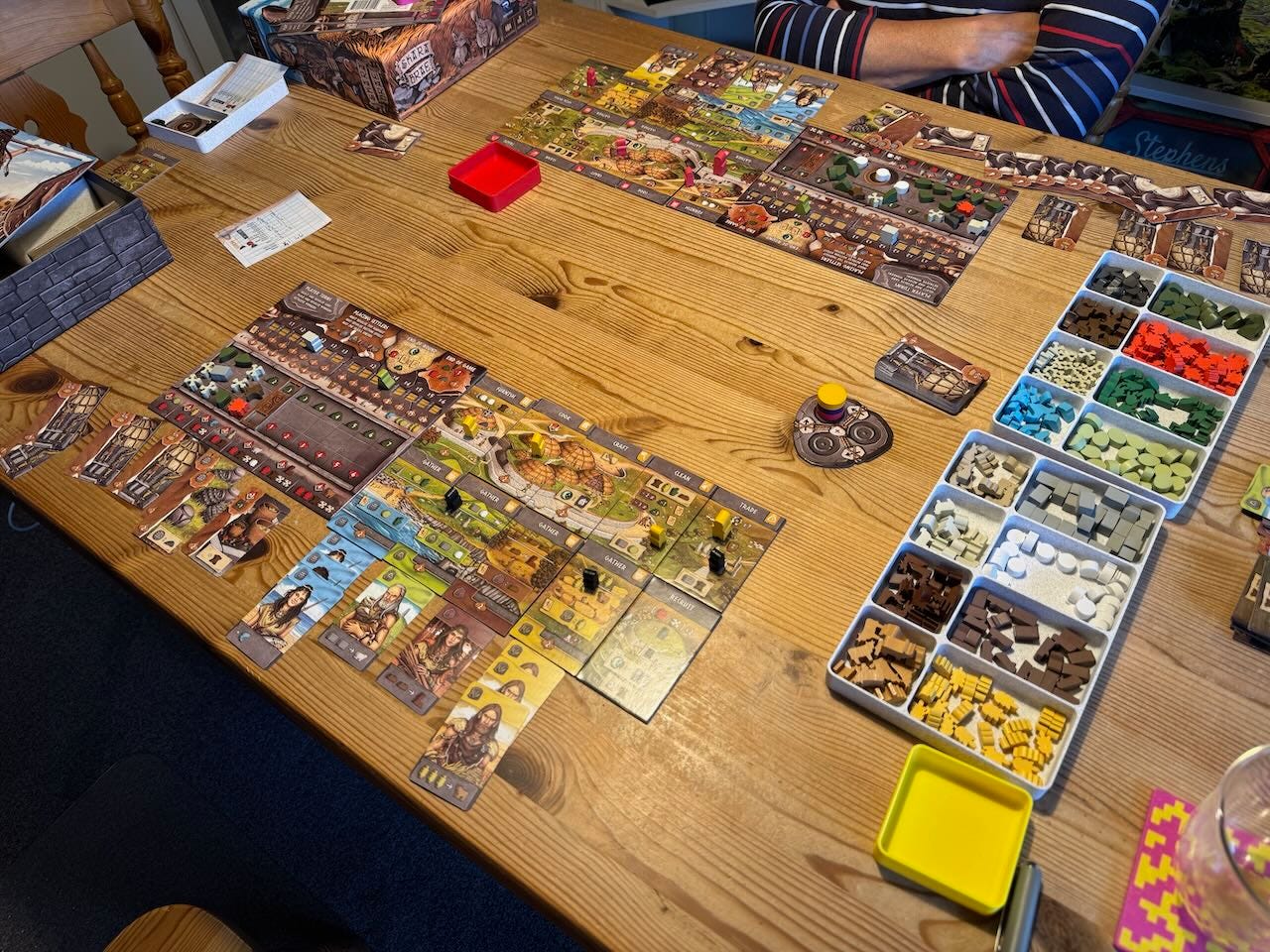
The card drafting is, essentially, the only bit of player interaction in the game — as soon as you’ve got your card for the turn, you’ll move on to playing your own little solo worker-placement game, on your own board, for the next 5 minutes, while everybody else at the table simultaneously plays their own little solo worker-placement game, on their own boards, for the same 5 minutes …and then you’ll all sync up at the end of the round ready for another card draft / another tiny bit of interaction.
(Is that a common thing in Garphill games? … I haven’t played many, but it certainly reminds me of the flow of Hadrian’s Wall!)
Repeat for 4 rounds of 3 drafts each, and then see who’s managed to build the best tribe.
Sounds awful?
Look… honestly… it’s not awful.
(I can already sense your skepticisim).
What makes it interesting? A few things, I guess. But maybe the principle thing that pulled me in — right from the first play — was the food production aspect of the game.
There’s nice, old-school “feed the family” phase at the end of every round. Many of your actions — particularly in the early game — will be devoted to building a food engine and stocking your provisions in preparation for this, with a constant tension between doing the stuff-that-you-want-to-do, and simply keeping your tribe fed. There’s a VERY similar pressure to Agricola going on here. And you know that I love me some Agricola, right? There’s a bite here which a lot of modern games lack.
However, the game also does an interesting thing of its own; a nice mechanism — grounded in the history of the real Skara Brae — which rewards efficient use of resources and the avoidance of excess production.
Essentially: accumulating goods has a side effect of producing “midden” … heaps of debris and rubbish. Every good that you produce needs to be put into a grid on your board, and as you fill that grid — from left to right — a sliding piece is gradually nudged right to indicate how much “midden” will be produced at the end of the round.
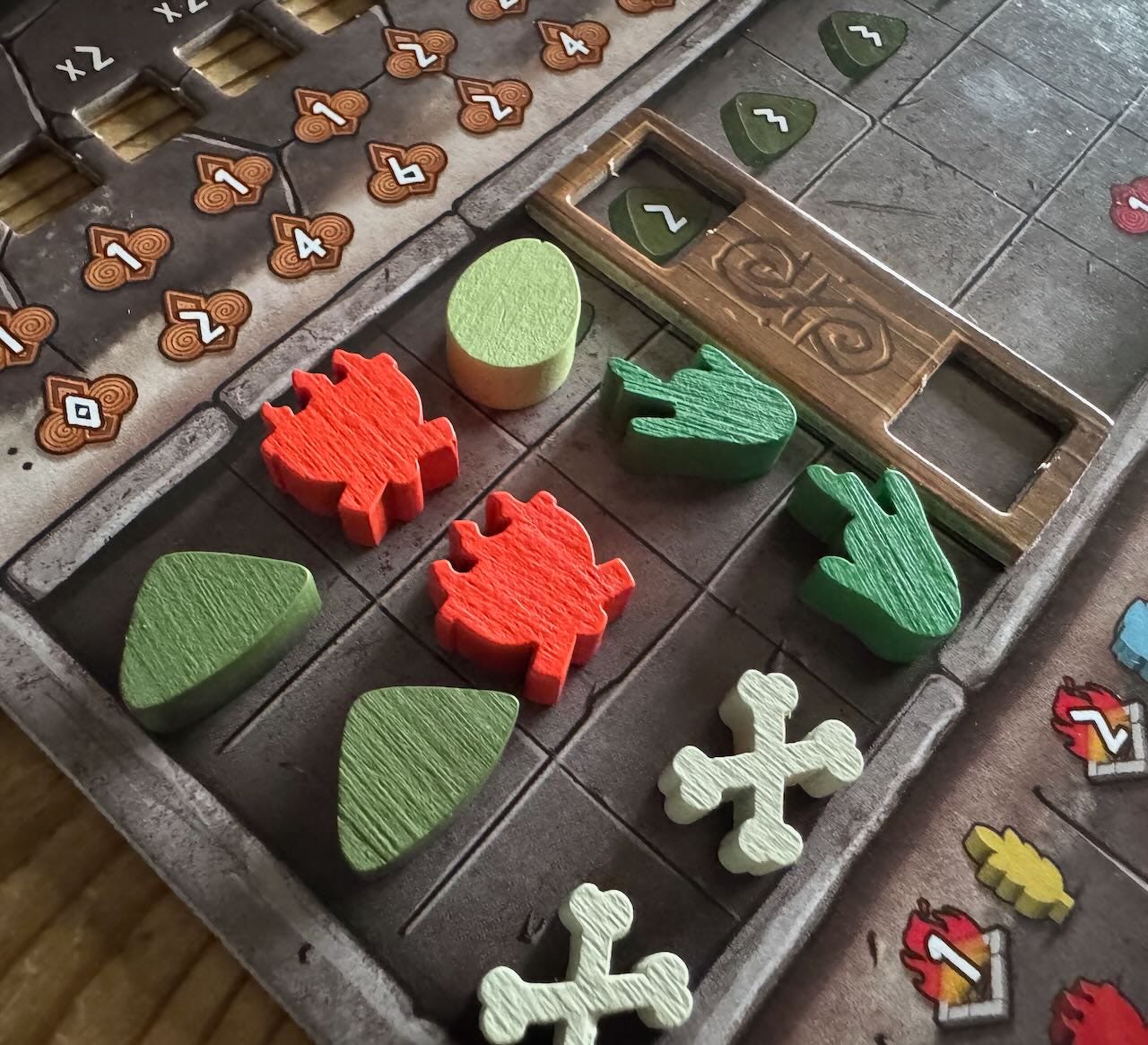
Immediately after the feeding phase, midden tokens will slotted into your inventory grid … clogging up spaces, and pushing the midden-production indicator even further to the right for future turns.
In real-life Skara Brae, these midden mounds were eventually “recycled” into new homes; hollowed out by subsequent generations of settlers, and turned into new living spaces. The game provides an action space to represent this process; a “cleaning” action which allows you to remove midden tokens from your inventory grid, and grants you a “roof” card in return … each roof that you gain reduces your feeding requirements by one person (useful!) … and any residual midden at the end of the game that you didn’t clean up (/turn into homes) gives you penalty points. So there’s another interesting dilemma going on there — efficient use of resources, vs tidying up the consequences … vs just letting the whole settlement go to wrack and ruin with massive heaps of trash, while you hope to be able to mitigate the lost points elsewhere.
(all while trying to “feed the family”, of course…)
Throw in one last significant wrinkle: Each tribe starts out with a unique “special action” space. Maybe your tribe will be the one that can hunt boar (a unique food/resource just for you). Maybe you’ll be the one who can spin wool … or recruit bonus workers … or are particularly good hunter-gatherers. There are 10 asymmetrical tribes in the game (two of them are kickstarter/promos, but the store that I bought my “retail” copy from threw them in as an unexpected freebie. Which was nice) … each bringing a different dominant strategy to explore / good bit of steering to guide you through the early game. And all of which should keep things interesting for quite a few replays.
Down sides?
There are a few:
Skara Brae is mostly multi-player solitaire, with only a soupçon of interaction each round; you might not like that.
There’s no possible way that those asymmetrical tribe powers are all pefectly balanced (and if you don’t like playing a game where your strategy is largely dictated by the super-power that you were assigned at the outset… well, this game probably won’t be for you).
Plus, the ramping-up of the game feels a bit … “off”; it feels like you do very little of consequence in the first round of the game … to the point where — after a few plays — you wonder why that first round is even there.
But on the whole … I’m pleased to have acquired this; I’ve been having fun with it. I very rarely repeat-play games in solo mode, but the solo variant of Skara Brae has felt oddly compelling.
…So it turns out that we won’t just be taking this with us on our Orkney trip just for the lols and the gimmick factor … we’ll be taking it because it’ll be a fun thing to play, with some solid thematic/mechanical links to the place that we’ll be visiting.
(Though … yeah … there might be interesting photo opportunities. But I’ll try not to drop anything expensive this time! 😉)

Really nice writeup, I'm not sure I would have given this game a second glance but now you've got me interested. I appreciate your even-handed review, I feel like I got an authentic description.